DESILO at CRYPTO 2026: Two Papers Toward Practical Private AI
 PR Team · DESILO
From a 5th-generation FHE built around matrix arithmetic to efficient bootstrapping — and a commercial library
For four days from August 17 to 20, the world's cryptography community gathered at the University of California, Santa Barbara (UCSB) for CRYPTO 2026, the 46th International Cryptology Conference hosted by the International Association for Cryptologic Research (IACR).
CRYPTO is one of the most prestigious academic venues in cryptography — the stage where important research results are first made public, then rigorously examined and debated by the researchers who know the field best. This year's main program featured 189 papers, published across ten volumes of Springer LNCS proceedings.
Among them were two papers DESILO completed through joint research. One presents a new fully homomorphic encryption structure suited to AI computation; the other deals with making bootstrapping — the step that decides performance in that structure — efficient. That two papers forming a single line of research were accepted to the same year's main program makes the result all the more meaningful.
The two studies are not independent achievements. They share one goal: completing, as a single arc, the foundational technology needed to make Private AI work in real environments.
Redesigning fully homomorphic encryption for AI
Fully Homomorphic Encryption (FHE) is a technology that makes it possible to compute on data without decrypting it. With FHE, an AI model can run without ever exposing the sensitive original data to the outside.
But being possible and being practical are different problems. Existing FHE can perform a wide range of operations on encrypted data, yet handling the large-scale matrix operations at the heart of modern AI still carries a substantial cost.
DESILO's first paper, 'Fully Homomorphic Encryption for Matrix Arithmetic', goes back to the design stage of the cryptosystem itself to confront this problem.
Craig Gentry (Cornami) · Yongwoo Lee (DESILO · Inha University)
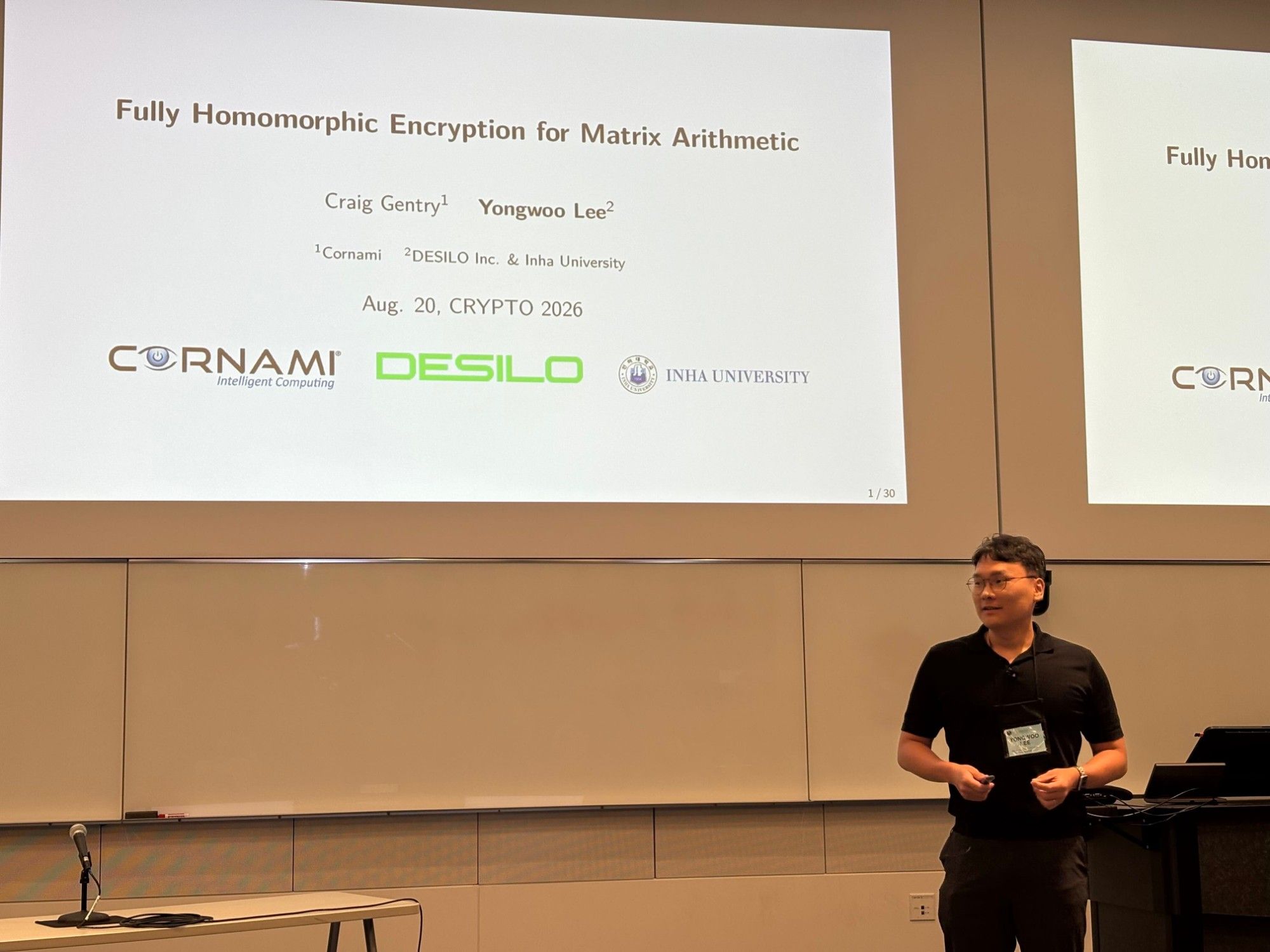
Yongwoo Lee presents ‘Fully Homomorphic Encryption for Matrix Arithmetic’ at CRYPTO 2026
The paper lays out the theoretical foundation of the GL (Gentry–Lee) scheme, the 5th-generation fully homomorphic encryption first unveiled at FHE.org 2026 earlier this year.
At the core of the GL scheme is to take a leap from treating matrix multiplication as a secondary operation to be processed on top of an existing cryptosystem. Instead, it places matrix arithmetic — the bulk of modern AI workloads — at the center and redesigns the structure of homomorphic encryption itself.
This goes beyond adapting a general-purpose cryptographic tool to AI; it is an attempt to build, from the ground up, an FHE suited to AI computation. That the GL scheme was presented at CRYPTO 2026 means this new approach now stands at the starting point for full-scale verification and extension by the global cryptography research community.
Redesigning all the way to bootstrapping, where performance is decided
FHE comes with an inherent constraint. As computation is repeated on encrypted data, noise accumulates inside the ciphertext, and past a certain level, accurate results can no longer be obtained. The procedure that resolves this is bootstrapping: it reduces the accumulated noise so that computation on encrypted data can continue.
At the same time, bootstrapping is the most time- and compute-intensive stage of the entire pipeline — in practice, the efficiency of this one step has determined the real-world performance of FHE systems. And for a cryptosystem with a genuinely new structure like the GL scheme, bootstrapping techniques developed for earlier schemes cannot simply be carried over; a method fitted to the new structure has to be designed from scratch.
That is exactly what the second paper, 'Efficient Bootstrapping in Fully Homomorphic Encryption for Matrix Arithmetic', accomplishes.
Eric Crockett · Craig Gentry (Cornami) · Hyojun Kim · Yeongmin Lee · Yongwoo Lee (DESILO · Inha University)
The paper presents an efficient bootstrapping method built for the GL scheme's matrix-arithmetic structure. By showing that the efficiency the GL scheme gains in matrix operations holds even at the most expensive stage, it establishes that the new cryptosystem is not merely a proof of possibility for shallow computation, but a complete system capable of carrying deep, complex, real-world AI workloads.
From design to performance, completing one system
Why the two studies matter together is clear.
The first redesigned the structure of fully homomorphic encryption around matrix arithmetic, the core of AI. The second made bootstrapping — the step that decides performance in that new structure — efficient, so that the advantage gained at the design stage carries intact through the heaviest stage.
In one sentence:
From matrix arithmetic to bootstrapping, an FHE redesigned from the ground up for AI runs real Private AI workloads.
What DESILO pursues does not stop at improving the performance of individual cryptographic techniques. The goal is to realize, as one practical system, the entire process in which data enters encrypted, is processed encrypted, and is returned encrypted.
And the results have not stayed on paper. The GL scheme is already integrated into the DESILO FHE Library. By turning the research into technology that can actually be used, DESILO provides the world's first commercial FHE library to incorporate a 5th-generation scheme.
This link from research to product reflects how DESILO approaches Private AI: proposing new cryptographic techniques is only part of the work — completing them as software and infrastructure usable in real environments belongs to the same research and development process.
The conversations beyond the sessions
The value of a conference like CRYPTO is not limited to paper presentations. The conversations and debates between sessions, and the exchange of perspectives among researchers and engineers from different fields, matter just as much.
On the weekend of August 15–16, five affiliated events — including the Privacy-Preserving Machine Learning workshop (PPML 2026) — were held on the same campus ahead of the main conference, and throughout the week, exchanges continued outside the official sessions as well, from the rump session of short, informal talks to the evening receptions.
Over the four days, DESILO's researchers met researchers and engineers from leading universities, industry labs, and companies working across the Privacy-Enhancing Technologies (PET) landscape.
These exchanges matter because FHE is moving past the stage of proving theoretical possibility and into deployable technical infrastructure.
That transition cannot be carried by any single company or research team. Academia, library developers, hardware acceleration companies, standards bodies, and application developers have to build performance, compatibility, and use cases together. DESILO is part of this current — participating in the fully homomorphic encryption standardization discussions at the U.S. National Institute of Standards and Technology (NIST) and the International Organization for Standardization (ISO), and with its encrypted inference system THOR adopted as the first reference implementation in the international FHE Benchmarking Suite.
Through CRYPTO 2026, DESILO confirmed new possibilities for collaboration and came away with a more concrete picture of where the FHE and Private AI ecosystem is headed.
Toward practical Private AI
Presenting two papers in the main program of CRYPTO 2026 is a meaningful milestone for DESILO. At the same time, it is not the destination of this research, but a waypoint toward the next stage.
The research presented in Santa Barbara is already flowing into DESILO's products. DESILO will continue to publish new results, turn them into working technology and products, and expand collaboration with partners in academia and industry.
An environment where the full value of AI can be realized without exposing sensitive data. AI that runs encrypted from beginning to end. DESILO is building a future in which Private AI is not a special option, but everyday technical infrastructure.
Read the papers
- Fully Homomorphic Encryption for Matrix Arithmetic
- Efficient Bootstrapping in Fully Homomorphic Encryption for Matrix Arithmetic
More about DESILO and Private AI is available on the official DESILO website.